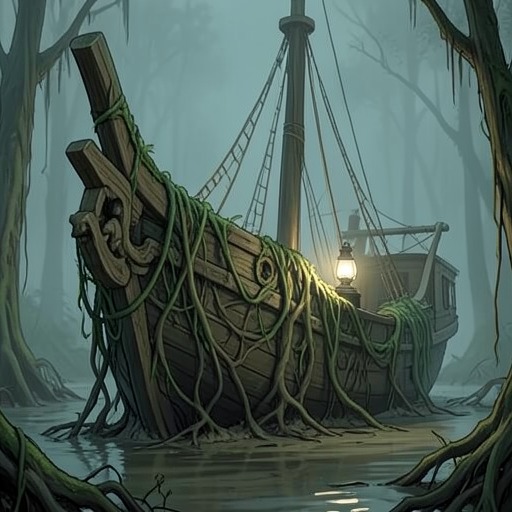
corpse-briar
Chasing Sunlightcorpse-briar is the dead, god-wrought substance encountered during the Endeavor’s passage through the remains of a colossal deceased being. It is not merely inert vegetation or an obstacle in the landscape: its corpse-like matter retains enough vitality and potency to affect the ship, the air around it, and the course of the expedition. Its destruction becomes one of the journey’s most consequential acts of ritual disposal and physical escape.
Appearance and Encounter
The corpse-briar forms part of the immense dead body that the Endeavor must cross or evade. The corpse is described as an ungraspable contortion of land and space, with a huge hollow eye and a fetid attention that seems to follow the ship as it breaks away from the grasping rot. Wandering trails of fire dust outline the corpse, and some paths appear to carry the Endeavor through the dead titan rather than simply above it. The briar is therefore embedded in a landscape where biological remains, terrain, and impossible spatial structures have become indistinguishable.
The expedition first confronts the corpse-briar as a material obstruction and source of danger rather than as a creature with a conventional body or behavior. The dead presence below still exerts attention, while the decaying surface threatens to hold the ship within its endless rot. Jonathan empties the last of the fire dust from a cask, replaces the lid, and returns to the bridge as the corpse’s regard creates an urgent need to prepare for departure. The encounter makes the corpse-briar part of a larger problem: the Endeavor must escape not only a ruined biological mass but also the residual agency and sacred danger of a dead godlike being.
Burning and Purification
The destruction of the corpse-briar takes the form of a funeral pyre. Antomine recites the burial words, “From dust ye were made and dust ye shall be,” while the people on the bridge observe the ceremony with solemn respect for the ancient and alien being. Antomine then tells Montgomery that it is time to light the pyre. Their agreement is unusual because Jonathan and Antomine otherwise pursue sharply different priorities, but both recognize that the corpse must be consigned to fire before the Endeavor can proceed.
Zint cannot serve as the fuel. Montgomery asks whether it will do, but Jonathan explains that zint does not properly set things aflame and that ordinary fire is required. Antomine offers the paper bearing the dead being’s name, and Montgomery lights it with a match before dropping the burning paper over the rail. The small brand falls slowly through the dead air, growing brighter as it approaches the corpse’s surface.
The result exceeds the scale of an ordinary fire. The flame dust ignites in a roar that consumes the land below, and the fire spreads through the corpse-briar in a violent convulsion. Flesh, bone, and even air burn as the fire purifies the god-derived remains. The event establishes a specific material rule: ordinary fire may fail against the briar, but matter wrought from gods can burn gods. The corpse-briar is thus both resistant to ordinary human technology and vulnerable to a ritualized form of destruction that matches its divine origin.
Effects on the Endeavor
The burning corpse-briar is not a contained funeral flame. Its heat catches the Endeavor and produces a sudden scorching wind that lifts the ship as the engines finally find purchase they had previously lacked. The vessel surges forward, and fresh air floods through its vents, driving out the fetor of the corpse while carrying the oppressive heat and smell of the pyre with it. The destruction of the briar therefore becomes a propulsion event: the dead matter that threatened to trap the ship supplies the force that helps release it.
The conflagration also transforms the surrounding darkness. Firelight illuminates miles of country, exposing blue and green terrain cut by sharp-edged canyons that resemble enormous claw marks. Far to the north, the blaze flickers across Widow’s Peak, outlining suggestions of a face and hands that are normally visible only in fragments. The corpse-briar’s burning makes the hidden geography legible for a brief time, turning the dead body into a final, terrible beacon behind the escaping vessel.
The crew’s relief is physical as well as emotional. As the Endeavor flees eastward, everyone breathes more easily, and the fresh air is welcomed despite the violence of the fire. The burning of the corpse-briar ends an interregnum of foul air, immobility, and proximity to the dead titan, allowing the expedition to resume its course toward Angkor Leng.
Residual Contamination and Narrative Function
The corpse-briar remains present after the immediate danger has passed through its smell. A week later, Eleanor still cannot remove the stink from her nose and sneezes into a handkerchief while complaining about it. Her dry response turns the briar’s aftermath into a recurring bodily reminder of the encounter: the expedition has escaped the corpse, but it has not escaped its contamination. The memory persists through an involuntary sensory trace rather than through heroic language or abstract reflection.
The corpse-briar also belongs to the expedition’s expanding catalogue of phenomena that exceed Jonathan’s journals. He recalls storms that turn iron to glass and glass to water, regions where time appears not to pass, and travelers from different epochs frozen together. The briar intensifies this pattern of discovery by showing that even a dead, god-derived substance can remain active, dangerous, and capable of altering the physical conditions of flight. Jonathan’s confidence that nothing remarkable lies between the corpse and Angkor Leng is consequently undercut by the evidence of how little his records can anticipate.
Its final significance is bound to Jonathan’s passage toward Bright Defile. The burning of the god’s corpse is later counted among the sacrifices that illuminate his path across the final barrier, alongside the death of Tiuni, the destruction of Tor Ilek, the sacrifice of Angkor Leng, and the loss of other attachments. In that retrospective structure, the corpse-briar is not an isolated monster encounter. Its destruction becomes one of the expedition’s irreversible offerings, a moment when escape, ritual purification, and the cost of pursuing sunlight converge.